
WHITEWASHED WALLS & ROMAN RUINS: A 5-DAY ITINERARY TO NORTHERN TUNISIA
Tunis / Carthage / Sidi Bou Said, Tunisia

Tunisia, officially the Republic of Tunisia, is a small Arab country in Northern Africa, is not yet on the radar the way Morocco or Egypt tend to be, and that is precisely the point. Tucked between Algeria to the west and the Mediterranean Sea to the north and east, Tunisia is part of the Maghreb region and is celebrated for its golden beaches, sunny weather, and a rich cultural tapestry that blends Arab and Berber influences. The country features a remarkable mix of Roman ruins, Andalusian architecture, and French colonial elegance, all harmoniously intertwined to create an identity that feels distinctly its own.
The northern region, encompassing Tunis, the picturesque village of Sidi Bou Said, and the historic site of Carthage, can be thoroughly explored and appreciated in a span of four to five days. Transportation is easy between the locations, both ride-share and public transport are available.
BEFORE YOU GO
GETTING THERE: Tunis-Carthage International Airport (TUN) receives direct flights from most European hubs, including Paris, Rome, London, and Frankfurt, and connects easily through Istanbul on Turkish Airlines. From the US, expect one connection. Flights from within Europe are short and often inexpensive.
GETTING AROUND: Within the northern circuit, taxis and Bolt are cheap and reliable. Download Bolt before you arrive. The TGM light rail connects Tunis, Sidi Bou Saïd, and Carthage if you prefer public transport.
HOW MUCH TIME: Five days is comfortable: two nights in Tunis, two nights in Sidi Bou Saïd, with a half-day excursion to Carthage. You can compress it to four days if your schedule requires.
BEST TIME OF YEAR TO VISIT
HIGH SEASON: (July and August) Hot, crowded on the coast, but the beach towns are lively and the light is extraordinary.
SHOULDER SEASON: (March - May and September - October)The best conditions overall: warm, sunny, far fewer crowds.
LOW SEASON: (November - February) Mild but occasionally rainy. The sites are quiet and accommodation is inexpensive.
DAY 1: TUNIS: CULTURE, COLOR, AND ROOFTOP VIEWS

Medina of Tunis
Walking Tour
Tunis Sign
Bab el Bhar.
Great Mosque of Zitouna
Cafe Panorama
Avenue Habib Bourguiba
Tunis, the lively capital of Tunisia, is the kind of place that blends old-world intrigue with modern Mediterranean ease. For solo travelers, it’s a perfect city to dive into North African culture without feeling rushed, though you’ll want to plan strategically to make sure you don't miss anything. The good news? Whether you linger over mint tea on a rooftop terrace or wander the maze of the Medina, Tunis reveals its charms at an easy, unhurried pace.
I flew into Tunis from Málaga and checked into a modern hotel about a twenty-minute walk from the city center. On arrival, Tunis looks more European than most visitors expect. People were dressed in a mix of Western and traditional clothing, women in abayas and headscarves alongside women in crop tops and shorts. As a solo female traveler, I dressed modestly on the first day out of respect and habit, and by day two I had read the room clearly enough to wear a sundress without a second thought. Tunisia is among the most Westernized countries in the Arab world, though assessing that for yourself on arrival is always the right call.
I always like to start my first full morning with a walking tour booked through GuruWalk or GetYourGuide. The guides thread you through artisan workshops and architectural details that no map will surface, and the context they provide transforms what would otherwise feel like a beautiful maze into something genuinely legible. Unfortunately, this time, the guide didn't show up. In many places the tours run on a regular schedule and you can just show up. But in less traveled areas, the tours might only run if there is a registered guest. I had forgotten about his and hadn't registered. So this one was my fault and meant this time I was on my own!
The Medina of Tunis has been a UNESCO World Heritage Site since 1979, one of the earliest Arab-Muslim cities in the Maghreb, established in 698 AD. Before entering, pause at Bab el Bhar, (the Gate of the Sea / Porte De France, The Gate of France) which marks the threshold between the medieval city and the French-built modern one. Then just head down one of the alleys and start shopping!

Inside, the Great Mosque of Zitouna anchors the quarter. Non-Muslims cannot enter the prayer hall, but the surrounding souks offer views of its centuries-old columns and a sense of the gravity the place holds. The souks themselves sell all kinds of items- from colorful ceramics to leather goods, woven baskets to handwoven carpets, western clothing to traditional arabic attire, and almost everything else.
After all that walking, find Café Panorama for a break. This is less straightforward than it sounds. GPS does not work reliably in the Medina, and when asking for directions, a friendly stranger will almost certainly offer to escort you somewhere else entirely and encourage a purchase and tip before you realize you have been redirected. I ended up on the rooftop of a random store, but left a small tip for the effort and had a laugh at the brazenness. The real Café Panorama is covered in beautiful mosaic tiles and offers an incredible and direct view of the Great Mosque pillar across a wash of white rooftops, with the call to prayer drifting up from the streets below. Order a fresh orange juice or mint tea and stay longer than you think you need to. The friendly staff chatted with me and gave me exact directions to my next stops- Sidi Bou Saïd and Carthage, entirely unprompted, and a number to call if I got lost. I loved this place. (Note: there are lots of bad reviews for this place for poor service or prices being too high. Personally, I think being friendly goes a long way and I don't mind paying extra for the beautiful view!)


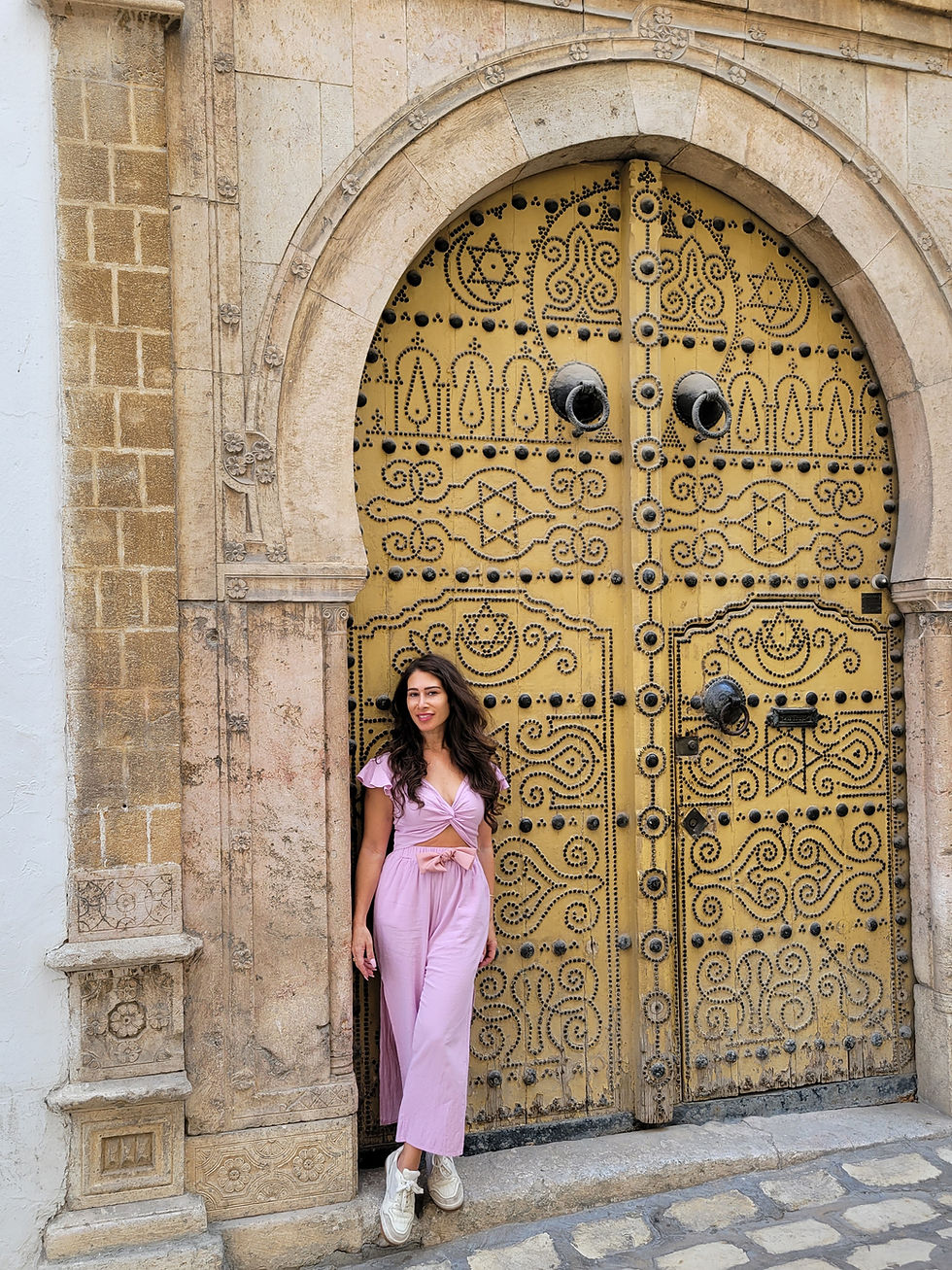

Then, somewhere between Café Panorama and wherever I ended up, I pretending I knew where I was going. The Medina does not mind. It has absorbed far more disoriented visitors than me. Getting lost in the Medina or the nearby streets is quite likely, particularly for someone like me who lacks a sense of direction. However, I found charm in wandering around and admiring the ancient architecture, especially all the unique and beautiful doors. And then when I was ready to get out, again, I asked for help - this time not from a random person, but from a hotel employee who was kind enough to walk me out to where I could get a taxi/Bolt.
If you have energy left after the Medina, you can continue shopping along the Avenue Habib Bourguiba, which is the main tree-lined street directly in front of the Medina. Lined with French colonial facades and bustling cafés, it’s a great place for people-watching. The surrounding streets are also a designer's goldmine as they are lined with fabric stores and notions for decorating or design at prices that will make you wish you had packed lighter. The streets here are much easier to navigate. I left with yards of silk and beautiful beaded trim.
DAY 2: TUNIS: MUSEUMS AND MODERN CULTURE
Bardo Museum
Palace of Kheireddine
Museum of Modern Art
Belvédère Park
Rue Sidi Brahim
Rue du Pacha
Dar El Jeld
Spend your second day in Tunis exploring the city’s cultural treasures. A mix of museums and palaces will showcase this regions history.

Begin at the Bardo Museum, just outside central Tunis. It houses one of the world’s most important collections of Roman mosaics, along with Carthaginian artifacts and and a substantial collection of Islamic art. The museum itself is a beautiful 19th-century palace, worth visiting as much for its architecture as for its exhibits. I found it so extraordinary that I ended up spending the whole day here, but you might want to combine it with a visit to one of the nearby palaces.
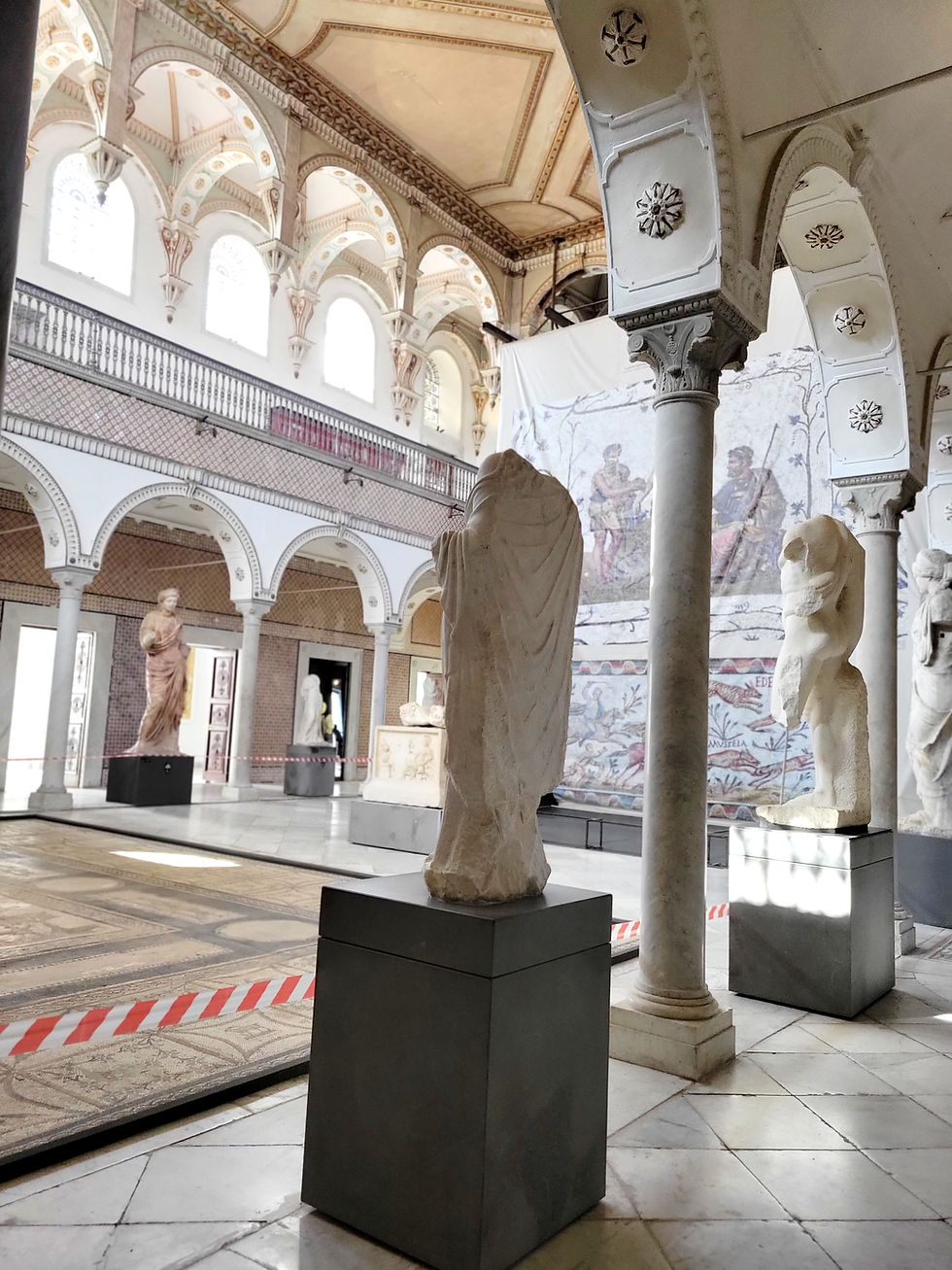
The museum itself is a beautiful 19th-century palace, worth visiting as much for its architecture as for its exhibits.
In the afternoon, a visit to the Palace of Kheireddine (Musée de la Ville de Tunis) is worth a stop. This 19th-century palace blends Tunisian, Ottoman, and European design in ways that feel less like a collision than an inevitability. It’s centrally located in the Medina and offers insights into colonial and pre-colonial architecture.
Take a break for lunch then head over to the Museum of Modern Art in or near Belvédère Park. The park itself is a great place to catch your breath and enjoy green space; the park itself is a good place to decompress after a heavy day of museums. the museum complements it with contemporary art from Tunisia. Alternatively, if you’re especially interested in architecture, explore Rue Sidi Brahim and Rue du Pacha in the Medina, which are full of palace-style homes, carved doors, and more interesting architectural details.

For you last evening in Tunis, Dar El Jeld in the Medina has a rooftop restaurant above its boutique hotel with a view worth booking in advance. It is the kind of dinner that closes a city properly. I had a delicious sea bream with sauteed vegetables and a glass of rose.
DAY 3: SIDI BOU SAID: IT ISN'T SANTORINI

Panoramic Point
Dar Zarrouk
Ennejma Ezzahra Palace
Beignets et Bambalouni
Villa Didon
Perched on the cliffs overlooking the Mediterranean, Sidi Bou Said, a coastal suburb of Tunis, boasts picturesque whitewashed buildings adorned with vibrant blue rooftops and doors, and bougainvillea trailing down narrow cobbled lanes. Perhaps Tunisia's most picturesque village —it’s small enough to explore in a day, but full of hidden corners, sweeping views, and stylish cafés that reward those who linger. On the Mediterranean, it is certain to give you Santorini vibes, without the crowds or cost.

On the third morning, I switched from my hotel in Tunis to an Airbnb in Sidi Bou Saïd. A taxi takes about thirty minutes and is the easier option, though the TGM light rail works just as well if you are traveling light. And Carthage is close enough to taxi, so it made sense to base myself here for both.
After settling in, I grabbed a Bolt to head to Panoramic Point, a lookout above the village. I found it to be more of a side vantage than a sweeping overlook , but it offered a pretty view of the blue rooftops all the way out to the sea. and it oriented me before walking down into the center. The main street is essentially one long descent: painters' galleries and hand-painted ceramics shops on either side, what the bohemian village is known for.

By now I was hungry, so I went to Dar Zarrouk, one of Sidi Bou Said’s most refined restaurants. The terrace overlooks the sea, and the atmosphere balances sophistication with a laid-back coastal vibe. The menu leaned toward upscale Mediterranean flavors — I chose sea bream ceviche topped with caviar, paired with an Aperol Spritz. I sat there relaxing and enjoying the experience. The sea breeze was doing its job and I saw no reason to rush anything. And the bill came to 70 TND, which is approximately $23 USD.

After lunch, I continued on the main street which turned down a sharp hill to Ennejma Ezzahra Palace. Built in the early 20th century by Baron Rodolphe d’Erlanger, a French painter and musicologist, who became obsessed with traditional Tunisian and Arab music and built a Moorish villa to house his collection - now a museum dedicated to traditional Tunisian and Arab music. The palace isn’t grand in scale but is rich in intricate tilework and period furnishings, offering a quiet glimpse into the colonial era’s artistic exchange. The architecture outside is also stunning, with a beautiful garden area and expansive outdoor terrace offers a 180 degree view of the sea.


The walk back up toward the main square is steep, but offers postcard-worthy views of the sea framed by the town’s signature white-and-blue façades. If you want a good workout, the views are worth it; otherwise call a ride.
Back in the center, I couldn't help but stop at Beignets et Bambalouni — where the scent of fresh, hot bambalouni, a Tunisian-style doughnut fried to order and dusted with powdered sugar- wafted through the air. I could tell this was not something to pass up by the constant queue, plus at just 1 TND ($ 0.30 USD), how could I? It was the perfect sweet pick-me-up between sightseeing stops.

As the light softens into evening, take a taxi to Villa Didon, a sleek, modern boutique hotel and restaurant perched on a hill with views stretching toward Carthage and the Gulf of Tunis. The outdoor terrace is especially popular at sunset — though to access the best seats, you’ll need to order a full meal. The penne with salmon in vodka sauce and a glass of Tunisian wine make for a relaxing dinner, though the real highlight is the tranquil ambiance and the view across the water.

While the sunset itself can vary depending on weather, it’s an elegant way to close out your day in Sidi Bou Said — watching the sky fade from gold to violet over the Mediterranean.
DAY 4: CARTHAGE: RUINS OF AN ANCIENT CIVILIZATION

Carthage Archeological Sites
Sidi Bou Said Harbor
Villa Bleau
A trip to Tunis without visiting Carthage is a trip with an obvious gap in it. Carthage was founded around the 9th century BCE as a Phoenician city, then rose to become the capital of a Punic empire that dominated the western Mediterranean for centuries. It was destroyed by Rome in 146 BCE during the Punic Wars with Rome, then rebuilt on the same ground under Roman rule. Over time, it evolved through Roman, Byzantine, and early Islamic phases, leaving layer upon layer of archaeology spread across a residential neighborhood that exists, with remarkable nonchalance, directly on top of all of it. Entry is covered by a single ticket that grants access to the full circuit.
You can easily reach Carthage with a taxi from Tunis or Sidi Bou Said, although it is closer to the latter. The Carthage Archeological Site ruins are spread across various areas so plan a walking route to see it all. They are comprised of :
Antonine Baths (Thermes d’Antonin / Baths of Antoninus): a massive thermal complex with foundations, corridors, partial mosaics and structure.
Byrsa Hill / Acropolis / Byrsa Quarter / Carthage National Museum (Byrsa Hill): ruins of temples, walls, fragments of Punic and Roman buildings, and excellent views over the bay. The museum sits atop Byrsa and was historically the repository for artifacts from across Carthage. It was closed when I visited and has been under renovation.
Punic Ports / Harbor Quarters / Tophet / Punic Neighborhood Ruins: These are the oldest parts of Carthage: harbor structures, sacrificial or sacred Tophet areas, remains of early housing and streets.
Roman Villas, Amphitheater & Smaller Ruins: Scattered among the zones are remains of private villas, a small amphitheater, bits of mosaic floors, columns, etc.
From my Airbnb in Sidi Bou Saidm I took a Bolt to the entrance to Carthage Archeological Sites at Byrsa Hill, here the Acropolis and the Carthage National Museum, which contains the largest collection of objects from the site of Carthage and covers the Phoenician-Punic, the Roman-African and the Arab-Moslem periods. sit. After paying admission, I walked out to a large area of - very ruined ruins. My honest experience: the ruins here are substantial but require more context to appreciate. The minimal signage identifies structures without offering much context about what they were for, and nothing to help you visualize what they once looked like. The museum was closed for renovation during my visit, which did not help. I wandered for a while trying to feel the weight of the place without being fully able to access it

Next, I decided to walk to the Antonine Baths. It was a relief to see this complex - Built under Emperor Antoninus Pius and once among the largest thermal complexes in the Roman world, the baths are exceptionally well-preserved. was exceptionally well-preserved. It is allowed to walk among the foundations, corridors, and partial structures, with the ocean visible just beyond the site. The scale becomes apparent as you move through it. But without someone to explain the details, I felt I couldn't fully appreciate the site.
So I would recommend hiring a guide, not as a polite suggestion but as a practical one. There aren't any guides on site, so make sure to do this in advance of your visit. From Carthage, I took a Bolt toward the harbor of Sidi Bou Saïd. The harbor is small and the beach beside it is nothing to write home about, which the guidebooks tend to omit. I walked past both without lingering and continued up to Villa Bleue, a luxury resort with a terrace perched above the water, where I settled in with two glasses of Tunisian wine and watched the sun go down over the sea. That part was worth it.


DAY 5: SIDI BOU SAID: SOAKING IT IN ONE LAST TIME

Begin your day in the village center, climbing the iconic staircase to Café des Délices. This is the heart of Sidi Bou Said — said to be where the village’s blue-and-white color scheme originated, inspired by Andalusian design brought here centuries ago. Order a cappuccino or mint tea, again at a premium price, find a table outside with the beautiful sea view, and enjoy the scene of artists, travelers, and locals unwinding in the shade.

The last morning began with a walk from Café des Délices down to Magnifique Vue, a lookout point that earns its name. The view from here stretches over the rooftops of the village and out across the Gulf of Tunis, the water catching the morning light in a way that makes you understand immediately why artists have been coming to this place for over a century. Paul Klee painted here. Simone de Beauvoir wrote here. It is the kind of view that makes you feel briefly, pleasantly irrelevant.
From there I wandered back into the village and spent an hour in the art galleries along the main street. The quality of work here is considerably higher than what you typically find in a tourist town of this size. Galerie A. Gorgi is the standout, one of the oldest galleries in Sidi Bou Saïd, focused on contemporary Tunisian painters and worth more time than a quick pass-through. I left with a small painting and no regrets.
I would also recommend ducking into Dar El Annabi, an 18th-century mansion near the center of the village that the family has opened as a museum. You are served mint tea on arrival, which sets the tone. The tour moves through bedrooms, a private library, a prayer hall, an Andalusian garden, and up to a rooftop terrace with views over the town. The rooms are dressed with traditional garments, ceramics, and furnishings that convey how wealthy Tunisian families actually lived here, rather than how they are imagined to have lived. I didn't make it because I had a flight to catch, but I would like to next time.
TRAVEL TIPS
TIP 1: Book guides in advance of going on guided walks or to the Carthage Archeological Site, as you cannot book on site. Use GetYourGuide, Viator, GuruWalks, TripAdvisor, or through your hotel or host.
TIP 2: Download the Bolt app - it operates just like Uber to book rides.
TIP 3: Although Western attire is prevalent, be sensitive to cultural norms. Choose long dresses or skirts over short shorts and bring a scarf for more conservative areas, such as near the mosque in the Medina.
FINAL THOUGHTS
Tunisia will not hand you the polished infrastructure of a European capital. The signage at Carthage leaves you guessing. The GPS in the Medina is unreliable at best. The beach is nothing special. None of that is a reason to skip it. It is, in fact, part of the point. What Tunisia offers in exchange is genuine discovery at a fraction of the cost: the Bardo Museum belongs in the same conversation as the great museums of Europe and most Western travelers have never heard of it, the architecture of Sidi Bou Saïd is quietly spectacular, and the value throughout is remarkable by any standard.
I came here on a detour from Spain, half-curious and without strong expectations. I left with a painting, yards of silk, beautiful photographs, and a strong case to make to anyone who will listen. Northern Tunisia is not undiscovered. It is underestimated. That, for now, is entirely to your advantage.


Comments