
BALI & BEYOND: AN ISLAND-HOPPING GUIDE TO THE BEAUTIFUL ISLANDS MOST PEOPLE MISS
The Lower Sunda Islands, Indonesia

Most people who say they've been to Bali have been to one version of it. They've done Seminyak beach clubs and Ubud yoga studios, maybe taken a day trip to Uluwatu for the sunset. They've had a wonderful time. And they've missed about eighty percent of what this corner of Indonesia has to offer.
What lies beyond Bali's southern shore — a loose constellation of smaller islands stretching east toward Lombok — is among the most quietly spectacular travel in Southeast Asia. The island-hopping circuit through Nusa Lembongan, the Gili Islands, and Lombok is not a new discovery, but it remains refreshingly under the radar compared to what most visitors experience when they land in Denpasar. The crowds thin. The pace slows. And the payoff is extraordinary.
I first made this journey in 2017, spending the better part of two months across Bali before venturing outward — arriving first in the surfer-filled energy of Canggu, then through the beach clubs and boutiques of Seminyak, up to the misty spiritual heartland of Ubud, and finally island-hopping eastward until I found myself watching water buffalo walk across a mirror-flat shore in Lombok. It was extraordinary. Each location offering something truly different and magnificent.
Here is how to do it — the places that deserve your time, where to stay, and the moments that will stay with you long after you've gone home.
BEFORE YOU GO
Getting There: Fly into Ngurah Rai International Airport (DPS). From the US, expect a connection through Tokyo, Singapore, or Taipei. Fast boat operators including Eka Jaya, Scoot Fast Cruises, and Gili Getaway connect Bali to Nusa Lembongan, the Gili Islands, and Lombok. Book in advance during high season.
Getting Around: Download Grab and Gojek before arrival — both offer fixed-price rides across Bali. In some tourist areas, local taxi guilds enforce no-pickup zones; your driver may ask you to walk half a block. Just go with it. For day trips, a private driver by the hour is affordable and genuinely useful. On the smaller islands, forget all of this: Nusa Lembongan has sandy lanes and no motorbikes; the Gilis have no motorized vehicles at all.
How Much Time: Allow 10 to 14 days minimum — three to four in Bali, two to three on Nusa Lembongan, two in the Gilis, three to four in Lombok. Both Bali and Lombok will absorb more if you have it.
Best Time to Visit: May through October is dry season — peak conditions for diving and island-hopping. May, June, and September offer near-identical weather with noticeably smaller crowds and better value. November through March brings the wet season and rougher
BALI
The island everyone knows — and still worth knowing better
Let's be honest about something first: Bali is large, and it is not one thing. The island you experience depends almost entirely on where you base yourself. Get this wrong and you'll spend your days navigating traffic jams between indistinguishable tourist strips. Get it right, and you'll understand why people keep coming back.
The southern coast — Canggu, Seminyak, Kuta, Legian — is where most visitors land and most of the action is. Of these, Kuta is the one to avoid: it is the most developed, most crowded, and least representative of what Bali actually is. Give it a pass. Seminyak and its cooler younger sibling Canggu are where you want to be for beaches, nightlife, and the island's world-class food and cocktail scene. Inland, about an hour's drive north, sits Ubud — a different universe entirely. And on the dramatic southwestern tip, Uluwatu offers clifftop temples and serious surf.
SEMINYAK
Seminyak is Bali's most polished coastal neighborhood — a long strip of wide beach lined with some of the best beach clubs in Southeast Asia, anchored by excellent restaurants, boutique shopping, and a nightlife scene that ranges from chic sundowner bars to full-on parties. It is the easiest place on the island to spend a week without once feeling like you've run out of things to do.
The beach clubs here are genuinely world-class. Potato Head is the institution — an architectural landmark as much as a venue, with a dramatic semicircular pool and programming that draws an international crowd.
Savaya (formerly Ku De Ta and everyone still calls it the old name) was the original Seminyak sunset destination.
La Laguna, hidden slightly off the main drag, is the most magical of the lot: strung with lights, decorated with vintage curiosities, it feels like wandering into an enchanted garden. I ended up at a table there one evening alongside a group of long-term expats who had clearly adopted it as their living room — the kind of accidental company that only happens when a place is genuinely special. Sit on the lawn at golden hour with a glass of wine and you will feel, without question, that you are somewhere outstanding..
For dinner, Motel Mexicola is an experience as much as a meal — a neon-lit fever dream of Day of the Dead imagery and Mesoamerican design that shouldn't work but absolutely does. Biku, set in a restored antique shop, is a perennial favorite for lunch. Favela has the same design-forward energy as Mexicola but leans more Southeast Asian in its aesthetic. The food all over Bali is consistently excellent and remarkably healthy - fresh produce, tropical fruit, vibrant vegetable dishes - and Seminyak represents it at its most polished.
And for a chill afternoon lounging, head to W Bali, to enjoy delicious food and a pool directly facing the ocean.


CANGGU
Just north of Seminyak, Canggu occupies an interesting middle ground between beach-town coolness and full tourist infrastructure. The surf is better to learn here than further south, which means the crowd skews younger and more transient. The beach has a lineup of casual bars and restaurants — more low-key than Seminyak, livelier in the way that places with a rotating population of long-term travelers tend to be. Finn's Beach Club, at the northern end, is the closest thing Canggu has to a proper high-end venue — think multiple pools, a bowling alley, and an events program that brings in significant names. It's worth an evening.
Canggu is better as a stop than a base for the upscale traveler. Spend a day or two, use it to surf or decompress, then move on.
ULUWATU
Down on the southern Bukit peninsula — a dramatic limestone headland hanging off the bottom of Bali — Uluwatu is one of the island's most visually striking areas. The cliff roads here are lined with surf camps and increasingly sleek resort developments, and the shoreline below is defined by world-class breaks that attract serious surfers from around the world.
The approach to Uluwatu Beach itself requires a slightly treacherous walk down the cliff face to a rocky cove - not great for sunbathers, but worth it for the drama.
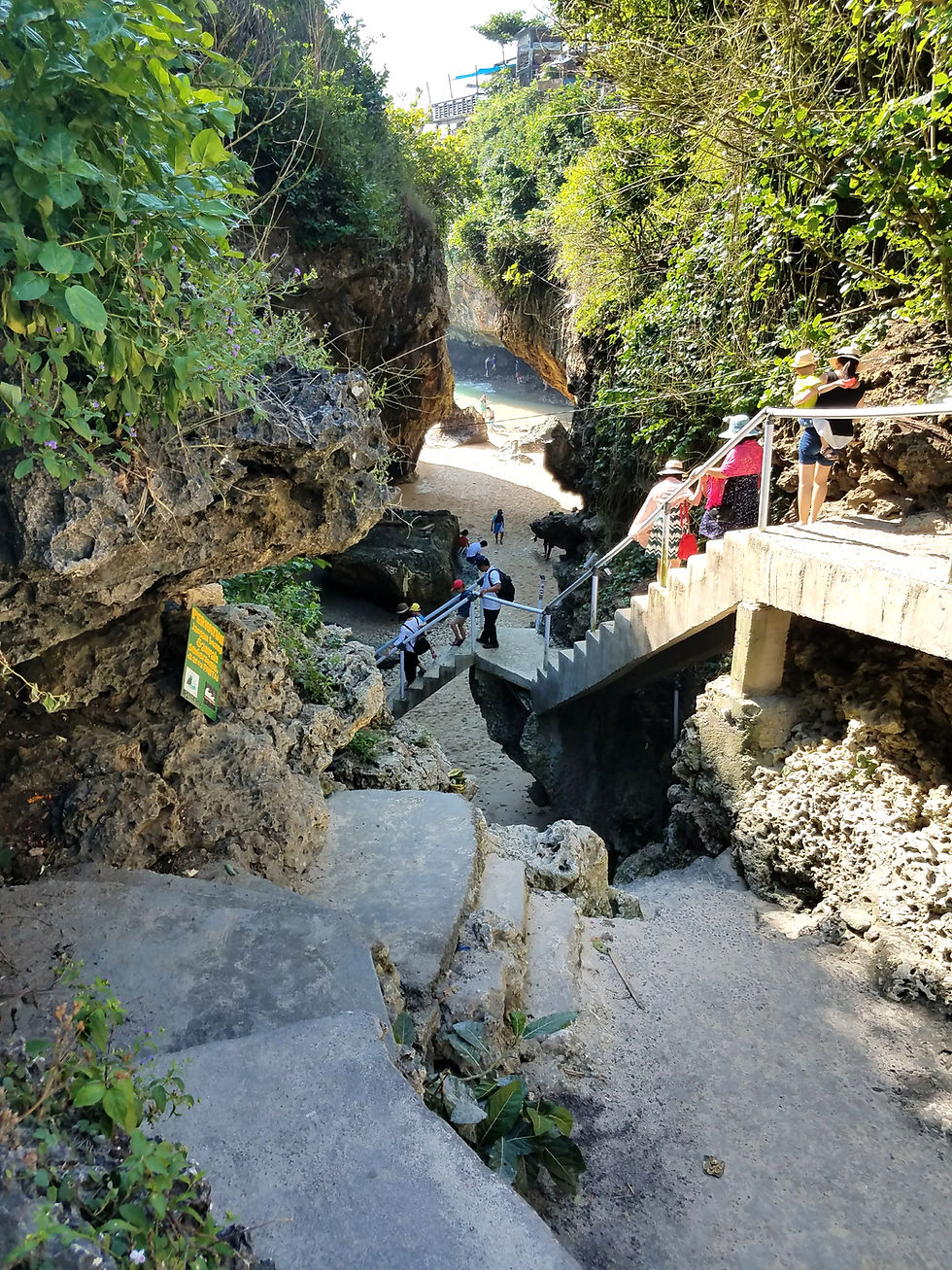
New Kuta Beach (formerly Dreamland Beach) nearby offers a long, single powerful wave rolling in from the horizon that is genuinely mesmerizing to watch. When a local surfer I'd met offered to take me on a walk above the cliffs - I could see the whole bay laid out below, one perfect wave after another rolling in from what felt like the edge of the world.
But Single Fin is the reason most non-surfers make the journey: a multi-level bar perched directly on the cliff edge with sunset views among the most spectacular on the island. Get there an hour early so you don't miss a minute of it.

Also worth mentioning, the Pura Luhur Uluwatu Temple, perched on a 70-meter cliff, hosts a Kecak fire dance performance at sunset that is genuinely worth seeing — theatrical, loud, and completely atmospheric with the ocean below. One more note: hold onto your sunglasses around the temple's resident monkey population. They are bold and have a well-documented interest in accessories.
UBUD
Ubud is where Bali becomes something else. About an hour's drive north and inland from Seminyak, it sits at elevation in the island's lush center - rice terraces cascading down the hillsides, dense tropical forest, and a cultural depth that the beach towns simply don't have. It is also, if I'm being honest, somewhat overrun with a particular kind of spiritual tourist - yoga-clothed women seeking the Eat, Pray, Love experience, boutiques selling crystals and meditation cushions, cafés serving activated charcoal smoothies. None of this is inherently bad. It just means you have to look a little harder for the Ubud underneath the Ubud.
It is worth looking.
The Sacred Monkey Forest Sanctuary on the southern edge of town is one of the stranger experiences Bali offers: a dense, moss-covered forest of ancient stone temples, eroded carvings, and several hundred long-tailed macaques entirely accustomed to humans. Imagine Tomb Raider set in a living ecosystem - it is photogenic in a way that is almost unfair, and it rewards the visitor who goes early, before tour buses arrive. Don't bring food, don't make eye contact with dominant males, and hold your bag firmly. I was mildly terrified the entire time and still would go back tomorrow.
The Kecak Fire and Dance, at the Pura Dalem Taman Kaja Temple in the evenings, is the kind of thing that, done anywhere else in the world, would feel like a tourist trap. Here, surrounded by torchlight with the evening air coming off the rice fields, it is the opposite: an authentic window into Balinese Hindu ceremony and performance tradition. Tickets are sold throughout town.

Yoga Barn is the institution for wellness in Ubud; it is larger and more professionally run than most of its competitors, with their exceptional organic Garden Kafe attached. If you aren't into yoga or their other wellness programs, the food at the cafe and the ambiance of the lounge is still worth a visit. I did a Tibetan Sound Bowl Meditation there that was a rather memorable experience. For yoga, I preferred Taksu Spa and Yoga, a smaller and more intimate space, and worth it for the quality of instruction. For one of the most peaceful meals you'll ever have, follow the Sari Organic Walk through the working rice fields (a path that used to lead to Sari Organic Cafe but closed in 2018) where you will encounter some small cafe's in a place that is entirely off the map.
For dinner, Nusantara s the standout — sophisticated, deeply seasonal, and one of those rare restaurants where everything on the plate seems to have been considered carefully. The food across Bali is consistently excellent and remarkably healthy: the kind of cooking that makes you reconsider everything you eat at home.
WHERE TO DINE — BALI
Biku — Seminyak's finest lunch spot, set in a restored antique shop.
Café Mexicola — More experience than restaurant — go at least once.
La Laguna — Seminyak's most magical beach club. The lawn at golden hour.
Nusantara — Ubud's best restaurant. Seasonal, considered, book ahead.
Sari Organic — Farm café at the end of a rice field walk. Go for lunch.
Yoga Barn Café — The best organic eating in Ubud, attached to the wellness center.
WHERE TO STAY — BALI
Luxury — Seminyak
The Legian Seminyak — 67 suites on a private stretch of sand. Intimate and understated.
W Bali – Seminyak — Direct beach access, stunning pool, reliably excellent.
Alila Seminyak — Contemporary architecture and one of the island's finest spas.
The Oberoi Beach Resort — 15 acres of tropical gardens. A Bali classic.
Mid-Range — Seminyak
Hotel Indigo Bali Seminyak Beach — Best mid-range option on the strip.
Luxury — Uluwatu
Bulgari Resort Bali — Private villas above the Indian Ocean. The most exclusive address in the area.
Alila Villas Uluwatu — Clifftop infinity pool, dramatic ocean views.
Karma Kandara — Private beach accessible by funicular with stunning views from the pool.
Luxury — Ubud
Mandapa, a Ritz-Carlton Reserve — On the Ayung River, surrounded by rice fields and forest. One of the finest in Indonesia.
Four Seasons Bali at Sayan — Extraordinary valley setting, 15 minutes from town.
Capella Ubud — Tented jungle villas with saltwater pools.
Alila Ubud — The iconic valley infinity pool.
Mid-Range — Ubud
Bisma Eight — Stylish, well-located, with rooftop pool views that rival the luxury properties.
NUSA LEMBONGAN
Fast boat from Sanur Beach, Bali — approximately 30 to 45 minutes

Nusa Lembongan is Bali's exhale.
The island is tiny — just eight square kilometers — and the contrast after the intensity of Seminyak or even Ubud is immediate and profound. There are no taxis, no motorbikes grinding up the road, none of the noise and hustle of the mainland. What you get instead are sandy lanes, turquoise water, a string of beach restaurants and bars along the western shore, and a pace of life that feels almost medicinal after even a few days of full-speed Bali.
The most developed areas are Jungut Batu Beach in the northwest - the longest stretch of sand, with the best concentration of restaurants and accommodation - and Mushroom Bay to the southwest, calmer and more sheltered, ideal for swimming and water sports. The hiking along the island's western edge is quietly spectacular: you walk under arching bougainvillea with the ocean visible between the branches, passing small clifftop viewpoints that appear suddenly and then are gone.
Offshore, if you want an incredible experience - Nusa Lembongan is one of the best places in Indonesia to swim with manta rays - large, impossibly graceful creatures that congregate in the channel between Lembongan and its neighbor Nusa Penida. The ocean around the channel can be surprisingly rough (the current is strong), so non-swimmers should factor in their comfort level. I am not a strong swimmer, and I made it under one giant manta before retreating to the boat in a mild panic. It was still one of the most surreal things I've ever done.
I sat with a glass of wine watching the reflection of the palm trees in the water and had the feeling — with total clarity — of being exactly where I was supposed to be.
For the more adventurous, Nusa Penida — the larger, wilder sister island just across the channel — has seen significant tourism growth in recent years, driven by its dramatic coastline and now-iconic formations like Kelingking Beach and Angel's Billabong. It is rawer and more rugged than Lembongan, and worth a day trip if you have the time and the legs for it.
Accommodation on Lembongan trends boutique and intimate — there are no international hotel chains here, which is precisely the point. Batu Karang Lembongan Resort & Spa sits on the cliffs above the water with plunge pools and unobstructed ocean views; it is consistently rated the finest property on the island. Mahagiri Resort, positioned above Jungut Batu, offers a beautiful pool with a view that becomes particularly magical at sunset.

WHERE TO STAY — NUSA LEMBONGAN
Luxury
Batu Karang Lembongan Resort & Spa — Cliffside plunge pools, unobstructed ocean views. The island's finest.
Lembongan Beach Club and Resort — Private pool rooms and an executive lounge.
Mid-Range
Mahagiri Resort — Beautiful pool above Jungut Batu. Magical at sunset.
The Tamarind Resort — Sea-view rooms with a strong reputation for service.
THE GILI ISLANDS
Fast boat from Bali or Nusa Lembongan — approximately 1.5 to 2 hours
The Gili Islands are three small coral islands sitting off the northwest coast of Lombok, each with its own distinct personality. The single rule that binds them all: no motorized vehicles. Transport is by horse cart (cidomo) or bicycle, which lends the islands an unusual quiet that feels genuinely luxurious. You arrive and immediately slow down, whether you intended to or not.
GILI AIR
The Quiet One
Gili Air is the most serene of the three — large enough to have proper restaurants and a handful of boutique resorts, small enough that you can walk the circumference of the entire island in under two hours. The west-facing shore catches the best sunsets in the archipelago: extraordinary pinks and purples over Bali's distant volcano, the water drawing back at low tide to reveal shallow channels and the occasional beached traditional boat, creating compositions that seem almost too beautiful to photograph. I stood at the water's edge one evening and watched the light change for the better part of an hour without once reaching for my phone. That almost never happens.

The vibe here is quiet and contemplative. The dining scene has evolved considerably — there are now proper restaurants serving fresh seafood at tables set directly in the sand, candlelit at dusk with the ocean a few feet away. It is the kind of dinner that is entirely about where you are.
GILI MENO
The Honeymoon Island
Gili Meno is the smallest and quietest of the three, with a protected lagoon on the east side that makes for exceptional snorkeling — sea turtles are reliably spotted here, often in the shallows just offshore. It is the romantic choice: few bars, few organized activities, a pace so slow it borders on motionless. Not for everyone, but perfect for the right kind of traveler, and popular with couples for a romantic getaway.
GILI TRAWANGAN
The Party Island
Gili Trawangan ('Gili T' to regulars) is the liveliest of the three - the most developed, the most crowded, and the most fun if your definition of fun includes a beachfront strip that becomes one continuous open-air party from sundown until well past midnight. The water is still beautiful, the diving is excellent, and there is a swing out in the ocean that has become one of the more photographed spots in all of Indonesia.


I arrived on Gili T on the last day of Ramadan, the Muslim month of prayer and fasting, having met a group of people on the boat over who I ended up spending the night with. By 4:00am we had decided that sleep was for another island. At 5am, the mosques - numerous and enthusiastically amplified- settled the question entirely. The call to prayer at that volume, at that hour, after that night, is a memorable experience. I say this with genuine affection: the festivity of Eid al-Fitr on the island is something to witness.
WHERE TO STAY — THE GILIS
Luxury — Gili Air
Slow Private Pool Villas — The top-tier pick on the island. Beautiful, sustainable, genuinely luxurious.
Villa Tokay — Private pool villas with exceptional service.
Ama-Lurra Resort — Consistently praised for atmosphere and setting.
Mid-Range — Gili Air
VYAANA Resort — Calm, elegant smaller property. Garden cottages and a pool that fits the island perfectly.
Gili Air Sanctuary Villa and Resort — Well-reviewed for service and value.
Luxury — Gili Trawangan
Pondok Santi Estate — A quiet sanctuary — striking contrast to the island's nightlife reputation.
Kokomo Resort — Comfort without surrendering access to the action.
LOMBOK
Fast boat from the Gilis — 30 to 45 minutes. Or fly direct from Bali, 45 minutes.
If Bali is the island everyone knows, Lombok is the island they haven't gotten around to yet. Positioned just east of Bali, separated by a stretch of deep ocean, it is quieter, less developed, more agricultural, and, in my opinion, more beautiful and authentic in its rawness.
Lombok is predominately Sasak, an indigenous Muslim ethnic group with a culture entirely distinct from Bali's Hindu traditions. The people I encountered were uniformly gentle and warm, unhurried in the best possible way. There is a quiet thoughtfulness here that shapes daily life, the call to prayer drifting across the rice fields in the early morning, fishing boats heading out as the sky turns pale, and it lends the place a quality of sincerity that you feel but can't quite explain.
There is a quiet thoughtfulness that shapes daily life.
The landscape is staggering. Mount Rinjani, an active stratovolcano rising 3,726 meters, dominates the northern skyline and draws serious trekkers for the multi-day summit hike to its caldera lake. The south coast is defined by a series of wide, powdery beaches: Selong Belanak, Mawun, Kuta Lombok; largely undeveloped and extraordinarily beautiful. The interior is dense jungle and rice fields, cut through by rivers and interrupted by waterfalls. On the beach at sunset, a herd of water buffalo came passing through along the shore. The water was so shallow and still it was like a mirror.
Benang Stokel Waterfall is one of the more dramatic natural features on the island: multiple cascades falling against a wall of green vines from considerable height, the jungle pressing in on every side. A local man from the retreat took us there on motorbikes - his wife and young son on the same bike, all three of them entirely unbothered by this - and we communicated the entire journey through gestures and expressions. No common language, no translation app, just two parties figuring it out. When we arrived and stood at the base of those falls, just the five of us and the sound of the water, I thought: this is the thing that travel is actually for.

I came to Lombok expecting quiet and nature and found both in abundance. What I didn't expect was the yoga retreat I'd booked almost accidentally (I hadn't realized there was yoga- I just needed a place to sleep). Mana Eco Retreat, down a long dirt road in the hills above the south coast. The property is an oasis: thatched-roof bungalows arranged around a pool ringed with jungle, hammocks strung between palms, outdoor showers hidden behind bamboo screens. Their yoga program is exceptional - unlimited classes led by Balinese instructors, and acro-yoga sessions that, for a former gymnast, felt like coming home to something I hadn't known I was missing. I had booked just a couple days. I stayed ten.
WHERE TO STAY — LOMBOK
Luxury
Hotel Tugu Lombok — An art collector's fantasy on Sire Beach. Antiques, exceptional cuisine, genuinely singular.
The Sira, a Luxury Collection Resort — Private beach with Gili views. Exceptional service in a remote setting.
Selong Selo Resort and Villas — Panoramic ocean views from the south coast hills.
Mid-Range / Wellness
Mana Eco Retreat — Thatched bungalows, jungle pool, outstanding yoga program. The kind of place you don't leave when you planned to.
Jeeva Klui Resort — Small beachfront property on the northwest coast. Quiet and well-regarded.
TRAVEL TIPS
TIP 1: Transportation: Download Grab and Gojek before you arrive and connect a card - fixed prices, no haggling. In some areas drivers will ask you to walk half a block for pickup; local taxi guilds enforce no-ride zones near major venues, and it can take a while to get a ride. For day trips, a private driver is both affordable and more useful than any app.
TIP 2: Cash: Withdraw Indonesian Rupiah before leaving Bali's main tourist areas. ATMs are widely available in Seminyak and Ubud but scarce on the smaller islands. Bring more than you think you'll need.
TIP 3: Temples: Dress modestly — sarongs are available to borrow at most sites. The small flower offerings (canang sari) you'll find on every doorstep are freshly made each morning as devotionals to the gods. Step around them; they are not decoration.
TIP 4: Boats: Book fast boat transfers in advance during high season. Popular crossings fill up. Established operators: Eka Jaya, Scoot Fast Cruises, Gili Getaway. Seas between Lembongan and Penida can be rough - take precautions if prone to motion sickness.
TIP 5: Entry: Most nationalities enter on a 30-day Visa on Arrival, extendable once. Indonesia introduced a Bali Tourism Tax in 2024 - currently 150,000 IDR (approximately $10 USD) per visitor, payable online or at the airport. Confirm current rules before departure.
FINAL THOUGHTS
There is a version of this trip that is polished and planned to the minute - five-star hotels, private transfers, curated excursions. That version is lovely, and I've given you the pieces to build it.
But the version I keep returning to in my memory is simpler: wandering on cliffside paths under bougainvillea wondering what I'd see around the next turn, the night at Gili Trawangan when I met people on the boat and ended up somewhere I never expected, swimming in the ocean and having the sun blacked out by a giant manta ray swimming over me, the motorbike family who drove with us through dense jungle to a waterfall that had no tourists, no parking lot.
Indonesia rewards improvisation. Plan well, then hold your plans loosely. The best parts of any trip here are the ones you didn't plan at all.


Comments